 We’ve been doing a lot of songwriting in the piano studio lately and this FREE songwriting contest sponsored by KinderBach.com sounds like a nice add-on to make it even more fun for the kids! Entries must be received by June 19, 2012 and winners will be announced June 21, 2012. When you visit their website there is also a link for Contest Aid Pages. These include colorful cutouts and a staff to help kids put the composition on paper! For another idea on how to compose with kids, check out the post I did on my Songwriting Game. I’m going to encourage my students to submit some of their creations, how about you?
Month: April 2012
Stickers And Parents Oh My!

This one is an oldie but a goodie for motivating young students. No surprise here, but it’s worth mentioning just in case it’s slipped your mind. I know I had forgotten about the amazing motivational power of stickers until yesterday when one of my preschool piano players showed up for lessons and her mom said it was difficult to get her to practice last week at home.
Enter the amazing stickers! I took a blank piece of paper, folded it in half and told my preschooler that we were going to see if she could fill up the page with stickers. How were we going to do this? Well for each time she played her piece she’d get to put a sticker on.
But no we didn’t stop there! After she played the trouble spots a couple of times I told her I had a suggestion. Why don’t we get her to see if her mom could play it too? Of course she would have to be her mom’s teacher because afterall, I was busy teaching her! She absolutely loved the idea so her mom joined in the lesson and of course she earned stickers as well. Now we had two sticker sheets going! My student was excited to find out that not only would her mom get a sticker for practicing, she would get one also every time her mom played the piece.
Finally I had another suggestion. Why don’t we get you and mom to play it together? And yes, she loved the idea too. What 4 year old doesn’t want to do something special with their mom? The best part was that we recorded them playing and let them listen and judge their playing. Oh and as a bonus it was a perfect opportunity for a new vocabulary word: duet. Now my preschooler chants “a duet is when you do it together”
So what about home practice? Well the sticker sheet went home with a challenge to fill it up completely with no white spaces showing! When she brings it back she will get a something from my treat box. She couldn’t wait to get home and practice – I mean play!
Teachers, how do you get parents involved in the lesson? Parents, how do you get involved in practice at home? Share your wisdom in a comment below!
I’m a long time proponent of teaching music by using the music that your students love. In fact, my teaching plans for this summer center primarily around gathering students to play in groups that play music in specific genres – pop, gospel, contemporary Christian, etc. The following is a post that was reblogged by Laura Lamere and I am reblogging it here to highlight the benefit of creating opportunities for kids to play (music) together. I’d love to hear your reactions to this post! Tell me, if there was a program like this available in your area would you support it and or participate?
Why Teach?
I had an awesome teaching moment tonight during a piano lesson and I just had to share it here. A young student of mine who has learned all the pentascales but had not yet been introduced to the entire major scale, was previewing a piece where the C scale is used throughout. Now before I tell you what happened next I must tell you that when he was learning the pentascales I never referred to them as pentascales, only scales.
So as we previewed the piece for tonight I pointed out that for these passages he would have to figure out how to get 3 more fingers on his hand since his other scales only used 5 fingers. That’s when his mind went into super thinking mode and he said, “hmmm if it has 5 notes we should call it a pentascale because penta means 5!” Then he proceeded to play the whole major scale with correct fingering and everything!
All I could do was ask, “What do you need me for?”
And with a big Kool-Aid smile he said, “to encourage me.”
At the end of the day, that’s really what teaching is all about. I’m so thankful for the opportunity to be an encourager in the lives of the kids I teach.
What’s the greatest compliment a student has given you? Share it here and you’ll be encouraging everyone who reads this post.
More Fun Practice: Silly 6 Pins

Ever wondered how to get a kid to play the same passage more than once – let alone 6 times? Of course you have if you are trying to help a child learn to play piano! Here is a repurposed game that works extremely well for solving this problem. If you’ve downloaded my Weekly Practice Games Printable, you may have seen this game listed as one of the practice assignments. It’s the classic Silly 6 Pins Game. I tell my students to bowl to see how many pins they can knock down. They try really hard to get a strike which usually results in lots of pins getting knocked down. They get to play whatever passage or piece they need to practice one time for each pin they knocked down. I get really silly with it and take the pins they knocked down to the piano. Each time they play the piece, I ask them which pin they want me to throw away. And, yes, I throw the pin across the room (carefully, of course). Depending on the kids’ personality I might even let him or her throw the pin. Of course I only do that if I’m pretty sure the kid won’t tear up my studio with the pin! Warning: This practice game could take up a large portion of the lesson because kids want to play it over and over again. However, this results in songs well learned, and tricky passages terminated! In case you missed it, you can check out Fun Practice for even more sneaky ways to get kids to “Play It Again”.
What tricks do you use to get your piano player to practice?
Songwriting Game

Yesterday I came across a set of balls in my studio like the ones you see at places like Chuck E Cheese where the kids can get in a pit and just have a good time. I had purchased them a while ago knowing that eventually I’d get an idea about how to use them to teach music. Well yesterday was the day the idea finally arrived! SONGWRITING BALLS!
This is an activity that can be done with any instrument, not just piano!
The balls conveniently come in 5 colors. I purchased mine at Wal Mart. Of course in my mind the number 5 screams PENTATONIC SCALE. So, I chose one note of the pentatonic scale for each color. C – red, D – orange, E- blue, G- green, and A-yellow and wrote these one the balls. I made 5 sets of each color.
To play the game (which is really writing a song), place all the balls in a large hat or bag.
Then, using a composing worksheet such as the ones you can find on Susan Paradis’ site, determine how many balls to draw from the bag. You will need one for each note of the song.
Each time a ball is drawn from the bag, write the note name in the appropriate space on the composing worksheet.
Since we are only using the pentatonic scale for this song, any combination should sound nice. You could also specify that the first ball drawn will be the first and last not of the song.
Once you’ve got all the notes written on the worksheet, it’s time to play your new masterpiece!
Extensions – Add lyrics!
Use the G and C balls to demonstrate V-I progression. Add this to the end of your song to show how lots of songs end this way. Have your student play G-C up and down the chosen instrument.
Instant Motivation

Which Guitar Is Cool?
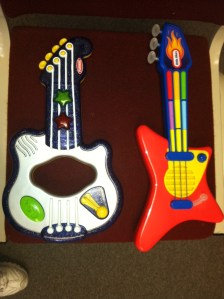
This post, while not about piano teaching is about kids and their perceptions of musical instruments. In one of my preschool classes a few weeks ago the boys were fighting over these two guitars. Everybody wanted the red one. When I asked them what was wrong with the blue one, they told me it was OK for the girls but it wasn’t cool enough for them. Wanting to know more, I asked what was so cool about the red one. They said, it has fire! If you’re interested in more about musical instrument stereotypes, head on over to http://arcticbassplayer.wordpress.com/2012/04/04/its-only-4-strings-dealing-with-music-related-stereotypes/#comment-80. Reading that post inspired me to share the picture above.
Nail Wars
 When I was a teenager, like many girls I started growing my fingernails. To me they were beautiful! The only problem was that I was a piano player. By that time I had played piano for 8 or 9 years and I never knew that long nails didn’t belong on piano hands because I never had any long nails. It just so happened that by this time I had had several different teachers and I had only been with the current teacher a short while. Needless to say, when she told me in no uncertain terms that I had to cut my nails I thought she was being mean and I ignored her.
She told me all the reasons (blah blah blah) why long nails were trouble for piano players:
1. They interfere with proper technique. Long nails prevent the fingertips from coming in contact with the piano keys, thus preventing the player from playing with the appropriate touch.
2. Long nails create a clicking sound that interferes with the music.
3. Long nails can get caught between the piano keys. When this happens, the nail can break and that hurts! Also, the musical flow is often interrupted because the player must stop playing to retrieve her finger from in between the keys.
4. Long nails make it nearly impossible to play fast.
5. It’s just not practical to play with long nails.
Besides the fact that I was operating with a teenage mind and didn’t want to cut my nails, this teacher and I had not yet built a solid relationship. (Actually that would take another 15 years or so to happen!) The bottom line is that I had no intentions of letting her tell me what to do with MY nails and I DID NOT CUT THEM… until a long time later when I got tired of trying to navigate long nails on the piano.
Fast forward to the present – Now I am the piano teacher and I have pre-teens showing up to lessons with nails that are not only long, but to further complicate things – they are purchased! This always happens every year with at least one student. The most recent incident happened just this week. Looking out the window in my teaching studio I could see my student and her mom headed for the door. Instead of the usual smiley face and bouncy walk, the girl was in tears and the mom was clearly angry. So I braced myself with my special invisible piano teacher fire extinguisher and opened the door.
The mom immediately showed me her daughter’s hands and explained that she was unaware that her daughter had put on these long nails just prior to the time for the lesson. She also told me to be sure to let her know if those nails interfered with her playing. And with that Mom was out the door! And there I was with an angry, kind of embarrassed pre-teen who didn’t understand what was so bad about having such pretty purple nails! Actually she was really upset about the fact that her mom had caught her before she could put the last nail on her thumb.
So… I patiently listened (Yay me!) As I listened I saw myself in her position and so I was able to validate her feelings. I intentionally left out the sermon about why piano hands should not have long nails because in that moment it didn’t matter. Instead, I shared my story with her about my teacher wanting me to cut my nails and I was honest with her about how I felt about it at the time. Then I showed her my nails. They are manicured and polished, but they are piano playing length short and they are beautiful. I let her know that it is appropriate – expected even – that she should want her nails to look good. It’s especially important for us piano players because people are looking at our hands and fingers all the time. I mean, when is the last time you took a video of your student or child playing the piano without showing her hands? I didn’t even tell her that she had to cut her nails. She will realize this in time. The last thing I did was ask her if I could take a picture of her nails so I could put it on this blog. She was happy to model her nails for me even though she knew that the picture was going to be used in a post about why piano players don’t have long nails.
After our talk we went on to have a wonderful lesson and when her mom returned she found her daughter smiling and bouncing like normal.
So what to do about girls and long nails?
Well if your daughter asks for long nails, don’t buy them or give her money to get them. Instead take her to the spa/salon and let her get a manicure (short nails). You could even suggest adding a pretty design as well.
A trip to the spa/salon could even be a reward for piano practice!
Secret Practice
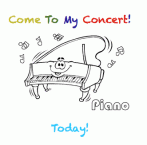
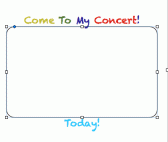 As we get close to Spring Performance time I am modifying what practice looks like for my younger students. They will be given the wonderful job of presenting a concert at home for family members! We’ll brainstorm ways to really ham up the performance with costumes, tickets, and maybe even snacks! I will tell them 1 or 2 songs that have to be part of the concert and they can add others if they like. Then at home they will give out invitations to their concert which can be printed here. There are two versions of the invitation. The first has a picture on the cover that they can color. The other one has a space for them to draw their own picture. Inside each invitation is a space to write the titles of the pieces they will play. You can download the files by clicking the images above. Once you print the file all you have to do is fold the paper in half horizontally and then fold again like a card. Presto! Instant kid concert invitations and a practice sessions with no tears!
If you want more ideas about how to make practice fun for kids see “Don’t Practice, Play A Game”
 Kids & Keys