How To Eat A Piano Piece

This is not how you eat a sandwich!

Piano students sometimes take on too much when learning a new piece. They attempt to learn a whole section at a time or even worse the whole song! When this happens in my studio I whip out this picture that my daughter so graciously agreed to take as a visual to remind students that we eat a sandwich one bite at a time. Then we chew. Then we swallow.

Translated for piano – we learn one bite at a time – maybe a measure or right hand only or whatever. Then we chew. Play what we learned several times before moving on to the next bite. By now the picture is enough to remind my students to take it SLOWLY!
Stay Calm!


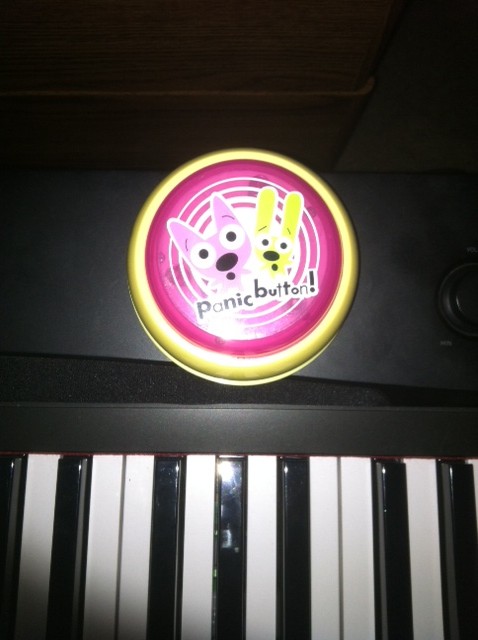
Recitals, performances, and anxiety – Oh My! Yes, it’s that time of year when limited time and looming performances can send piano students (and teachers) over the edge. So, I thought I’d share with you my new find that can lighten up the situation and make it more fun! Recently I got a new addition to go with the EASY button that sits on my teaching piano. It’s called the Panic Button. It features the familiar Hoops and YoYo characters from Hallmark and in true Hoops and YoYo style is HILARIOUS.
Whenever I see a kid approaching that point – you know the one where their eyes freeze up and frustration takes over – I say, “Quick Hit The Panic Button!” We both end up rolling with laughter as soon as they hit that button. I think this item is only available in stores but it is so worth a trip to the store!

Knock Knock Who’s There?

Knock Knock Who’s There?

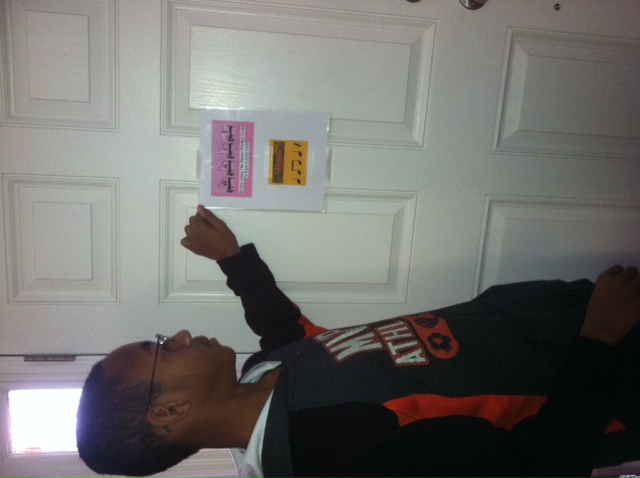
Recently I introduced a game I call “Knock Knock Who’s There?” in my music studio. When students arrive they see a secret rhythm code posted. To get into the studio they must correctly knock that rhythm. They also earn a gold coin (purchased from Party City) upon entry. Gold coins add up and the student with the most gold coins at the end of the semester gets an award. Oh and if a student doesn’t get the rhythm then I get to do what I do best – teach them how!
I have lots of different rhythm card sets, but with all the focus on candy last month I used the candy rhythm set from D’Net Layton’s site which you can get here.
Knock Knock Who’s There is a great way to begin the lesson by getting them thinking musically from the start. Parents are also getting in on the game. My students and I sometimes catch them standing outside trying to guess the rhythm when they come for pick up. We all get a kick out of it. A great way to end the lesson as well!

One More For Little Mozarts!

This is a great FREE app for all ages, but especially for the youngest piano players. Using the Piano Tab on the app kids can learn to play 5 familiar tunes  –  Twinkle Twinkle Little Star, Old Mac Donald, and others. The game works somewhat like Piano Wizard where the note to be played floats down to the key on the piano. I like the fact that it moves slowly enough for the kids to find the notes and it even waits while the kid does so. An added bonus is that kids using the Music For Little Mozarts method books will recognize a couple of friends on the screen – Mozart Mouse and Beethoven Bear! The graphics here are awesome and the colors are bright and fun. I can’t wait to introduce this one to my students! This app can be purchased for FREE in the apple itunes store. Did I mention that it’s FREE? What are your favorite music apps for younger piano students?

Play-Doh Re-Mi, Anyone?

Making A Staff

Sometimes it escapes me how much difficulty piano students have learning to read notes on the staff. You see, the more than 30 years that I’ve spent playing the piano have fooled me into thinking that reading notes on a music staff is EASY-PEASY. Not to worry – reality quickly sets in once my students sit at the piano and I put a sheet of music in front of them. The cheerful, excited faces they had during the pre-staff notation days of their lessons are suddenly absent – replaced by blank stares and a series of failed attempts at finding the right note. So, what to do?

Enter… Play Doh!

Step 1: Have the student make a staff. Some surprising revelations can occur at this time. Here’s one from a student: “There are only 5 lines?”

Step 2: Now the student can add space notes or line notes.  Another revelation: “You mean the space notes have to fit BETWEEN the lines?” 

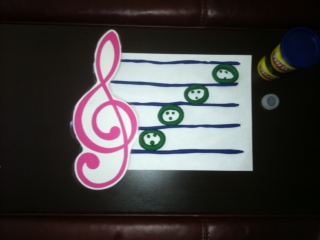
Happy FACE notes

Step 3: The teacher can add a Treble Clef OR Bass Clef. Then give the student the appropriate phrase to remember the note names. Now have them make up a phrase of their own.

Step 4: Take a picture of that beautiful smile your student is flashing!

3-D Bass Clef Staff