Ear Candy Game: Quarter Note Lollipops!

Here is a new game to help teach/reinforce note reading.

Materials Needed:

Small poster board or other heavy paper

Twizzlers Pull Apart Candy

Skittles

Dum Dum Lollipops

Ways To Play:

For group lessons: After making a staff and bass/treble clef using the Twizzlers, have the student(s) place lollipops on notes you specify.

For each note they properly place, they get to eat the lollipop or save it for after the lesson

____________________________

For private lessons: You can have the board completely set up with staff, clef, and notes made of lollipops and skittles. Then have each student choose a lollipop or skittle they want at the end of their lesson. They get to eat it ONLY IF they can correctly name the note.

____________________________

This game can also be used to help students identify note on lines or spaces.

For more advanced students you can have them play the melody built by the notes for a bonus take home bag of candy.

Introducing The Quarter Rest

Rests on printed scores are often ignored – especially by beginning piano students. I have my own ideas about the reasons why. At the top of this list is the fact that in today’s fast paced society silence is so rare that it has become a foreign concept to many. For others it is something to be feared and avoided at all costs! Musicians, however, know the value of a well placed rest. The well placed rest can convey a range of emotions and create magical moments in the music.

Here’s a quick way I introduced the quarter rest with my beginners last week.

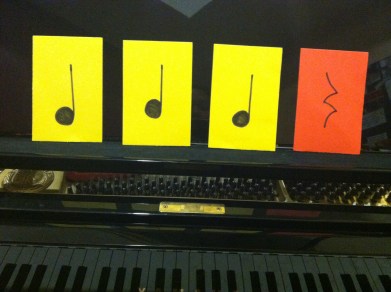
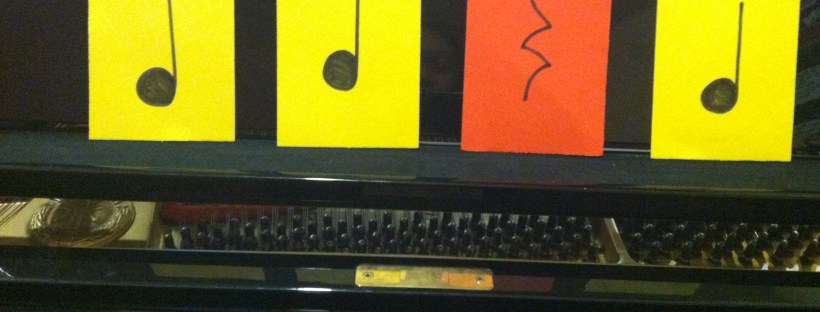
Starting from a familiar place – quarter notes drawn on foam flash cards. (You can purchase foam paper at the dollar store or a local craft store.) The student can play or stomp the rhythm. Younger kids may even like to do the Dinosaur Stomp!

Here comes the quarter rest silencing the last beat!

What happens to the sound if the quarter rest moves to a different spot?

Finally, what happens if we get rid of the quarter rest?

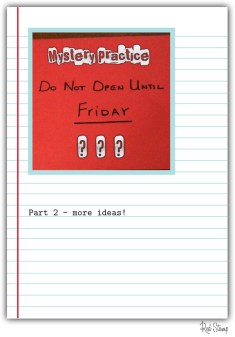
Mystery Practice Assignments Pt 2

Since last week’s post about Mystery Practice Assignments got so much attention on Pinterest and since my students seem to be enjoying the suspense involved in having to wait to find out what their practice assignment for each day is, I’ve decided to do a follow-up. Here are some of the mystery assignments I will be using this week. These are some of the tried and true favorites that I have used over the years in students’ notebooks as well as one idea that came from a comment on a post about How To Get Kids To Sing. Also, this week there will only be 4 mystery assignments – one for every other day. (Hmmm…could this be another way to reinforce the concept of skips?)

1.Place a small ball in the palm of your right hand. Wrap tape around the ball and your hand. Play the Treble clef notes of your practice piece without letting the ball slip out!

2. Using a kazoo, sing the first line of your practice piece whenever your brother or sister says your name tonight. (Thanks to Leila of 88pianokeys for this one!) Teachers/parents – for this one you may have to supply your student with a kazoo. This will actually add to the mystery since you will not tell him/her what the kazoo is for! You will only tell them that it is explained  in one of their envelopes!

3. Put on some dark sunglasses and play your piece with your eyes closed like Stevie Wonder. Were you able to play it without a mistake? If not, keep trying until you can!

4. Watch one of your favorite 30 minute TV shows and play your piece during the commercials. How many times were you able to play your piece?

For a printable copy of the assignments click here. There are enough for up to 4 students each. Simply cut strips and place in a sealed envelope for each day.

What To Do After The Lesson: A Checklist For Parents

Parents want to HELP their kids do well in piano but often don’t know how and are pressed for time. As a piano parent myself, I totally get it. So in the spirit of multitasking, here are 4 simple things parents can do in the car on the way home (or headed to the next destination) after lessons.

Just remember the word

H.E.L.P.

Highlights – Ask your child questions about the lesson

Encouragement – Make a positive statement about their piano learning

Let it go – Laugh about something. Anything.

Play – for the first 5 minutes at home have your child play something they started learning at the lesson.

You can print a copy of the checklist here to keep in your car!


Mystery Practice Assignments

This post is about the never ending practice war. You carefully write out assignments in your student’s notebook, slowly explain what you wrote, and you wait 7 days. Then you find out your student didn’t even look at the assignment sheet. You give your student a look of shock or disappointment and explain again why practice is so important. Repeat the steps from the previous week. The cycle continues.

I’m sure most piano teachers are familiar with the practice war and some may even have come to accept it as just a normal part of lessons. Well, the rebel in me is standing up today and saying NO! This has got to stop!

So, I have a proposal for any teacher who is ready to accept the challenge to end the war.

This will take a little advanced planning, but I’m betting it will be worth it. This week I’m giving students a different practice task for each of the 7 days in between lessons. My goal is for them to complete at least 5 of these tasks. If they complete all 7, they get to choose something from my treasure box at the end of the lesson. Here is where it gets interesting  – I will assign and explain a really cool practice activity for the first day like one of the ones in Shhh… Your Piano Teacher Thinks This Is Practice by Andrea and Trevor Dow. The other 6 assignments will be given to the student in sealed envelopes with the message – “Do NOT Open Until _________ “! The day of the week will be written on the line. Before giving the student the assignments, I will be making a list of them in my teacher notes so that I can use that in the following lesson.

I can’t wait to see how many of my students will take the mystery challenge!

Will you join me in this quest to end the practice war? Like and / or leave a comment if you’re on board!

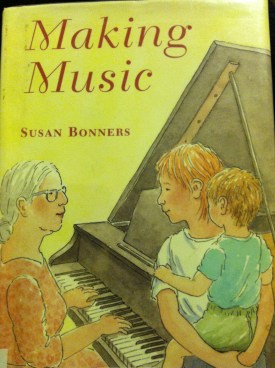
Book Review: Making Music by Susan Bonners

Here is a great book to add to your library of fiction books about piano lessons. Susan Bonners tells an engaging story of a young girl, Annie, who moves to a new neighborhood with her mom and little brother. The trouble is that they are moving far away from her Uncle who was teaching her how to play the piano. In the new neighborhood Annie is surprised to hear piano music coming from a neighbor’s house. As the story progresses we watch Annie and her neighbor  – who happens to be a retired piano teacher –  form an unbreakable bond because of the music.

Young readers who have an interest in playing the piano will easily relate to Annie as they read about how Annie struggles to remember the music her Uncle taught her before she moved away and how she eventually does remember HOW to remember! As a piano teacher, I constantly encourage young students to read fiction books about kids who play the piano or who want to learn to play. I believe that these stories are very valuable in validating children who take lessons by giving them characters who have similar desires and interests as their own. This is especially important because of the fact that piano learning is in so many ways a lonely pursuit.

The piano teacher in me enjoys reading these books because of the “knowing about the process” that is often depicted in them. For example, there is one line that jumped off the page as I was reading Making Music – “Teaching is tiring” the neighbor tells Annie when Annie asks her to teach her to play the piano. Simple relatable comments like that can be very refreshing because they are reminders that other piano teachers sometimes experience the same emotions that I do when it comes to teaching piano.

The story is a quick read that can be helpful for parents as well. Parents who read the book will get a glimpse into the mind of a young child who desires to play the piano and gain an even better understanding of lessons as it relates to their own child.

I found this book at my local library, but after reading it decided that I wanted to have my own copy. It is available through several sellers including Amazon.com.

What books are in your piano fiction library?

Printable Listening Sheet

Today I ran across a Listening Sheet that I designed a while back for my students. You can use it to encourage your piano students to actively listen to recorded music. Active listening has always been a skill that must be developed, but have you noticed that we are teaching the first generation of students who have never really listened to music without video? This makes it even more challenging for them to listen to the music itself.

This listening sheet allows the student to listen for what instruments are playing, what the tempo is, and what the time signature is. Notice that the space to write this information is located on the Bass Clef Staff. I did this to draw attention to the Bass Clef Staff since piano students often seem to not notice it. Here is just another opportunity for them to see it. There is also a spot where they can indicate whether or not they would like to learn to play the song – great info for a teacher to know!

You can download the file by clicking here or on the picture above. For more FREE PRINTABLES, click here.

4 Reasons To Watch the iTunes Festival Concerts Free Now!


The iTunes Festival has just concluded 30 Nights of Live Concerts and the iTunes Store is making the concerts available to watch FREE for a limited time. By clicking the pic above you can find out how to watch the concerts from your computer, mobile device, or your TV. There are many artists from a wide variety of genres represented.

Classical Music lovers will enjoy the concert by Andrea Bocelli as he sings “Amazing Grace”, “Time To Say Goodbye” and many more.

Fans of The X Factor will be happy to hear Rebecca Ferguson in concert with her Pop and R&B vocals.

World Music performer Laura Mvula, who studied classical composition is also included in this buffet of Free Concerts from the iTunes Festival.

My favorite new artist, Emeli Sande, has a fabulous concert as well! She performs her hit “Next To Me”, “Read All About It” and other tunes from her new album.

Can anybody say One Direction? Yes, they have a concert as well!

This body of concerts is a great opportunity for anyone who loves music, but it is especially great for music educators. Here are my top reasons for watching:

1. Discover new music

Here in one place you have some of the hottest artists from a variety of genres which makes discovering new music that students will love easy to find. There are links on the concert page to each artist’s iTunes page where you can purchase the music you like.

2. See your favorite artists in concert for FREE!!!

3. See Clear Video for Performance Examples  –

      Music educators can use clips from the concerts to point out on stage performance techniques to students

4. Preview music on upcoming CDs – 

 We all hate to buy music and later discover we don’t like it. Eliminate this possibility by watching the FREE Concert before you buy!


The Piano Lesson…Unplugged

Just as I was about 5 minutes from completing the 45 minute trip to my first Saturday piano lesson this past weekend I made a terrifying discovery – I had left the cord to my keyboard at home! Of course my mind began to race as I only had about 30 minutes before my lesson was to begin. I knew there was a Radio Shack nearby so I went there in hopes that I could buy a plug. I was relieved to learn that they had several different sizes of plugs. While the salesperson and I searched for a plug that would fit, someone came into the store and asked me about taking piano lessons. Needless to say I did give them information about my lessons but was cringing on the inside that their first encounter with me involved me not being prepared for my next lesson! Before I could get too frustrated about this fact, the salesperson informed me that she had tried every plug they had in the store and  none of them fit my keyboard! Oh no! Where was my panic button when I needed it?

I thanked her and quickly made a plan to utilize my iPad during the lesson to teach/review theory concepts. When I arrived at the lesson, I got my music bag out of the car and noticed my full-sized keyboard there in the passenger seat staring at me as if to say, “You are going to take me in, right?”

That’s when it hit me! When students tell me they could not practice because they were away from their piano I tell them they don’t ALWAYS need a piano or keyboard to practice. I tell them to envision the keyboard, hear the song in their head, and practice the movements their fingers must make to play the song. Aha! Now was the time for me to “practice…” – pun intended – “what I’d preached”!

A completely silent piano lesson? I had never done that before. How would my student respond to 30 minutes of silence at the keyboard?

Well, I unloaded the keyboard and put on my jazz face – it was time to improvise! I greeted my student and informed her that we would be having a “Play Like Beethoven Day”.

To refresh her memory of who Beethoven was I hummed a couple of his familiar tunes – “Fur Elise”, and the opening of his 5th Symphony. When I told her that Beethoven was deaf when he composed some of his greatest pieces she was of course surprised. So, if Beethoven could do it surely she could do it for 30 minutes.

That day my student learned that “hearing” the music inside your head is extremely helpful and important for good music playing. She also learned that she could do it. One of the biggest advantages to playing silently was the isolation of the skills necessary to play the piano. Without the “distraction” of sound, she was able to concentrate on what she was doing with her fingers and hands more intently than she had ever done before.

To help determine if she was truly hearing the music, at times I hummed the tune she was playing as I carefully watched her fingers. My student was both surprised and impressed at her own accuracy. It was quite fulfilling to see her correcting her mistakes as she played. Most of the time students neglect proper fingering in order to get to the correct note by any means necessary even at the expense of musicality. This silent situation, however, left my student with nothing to fix except her fingering!

I have to say that this Unplugged Piano Lesson was one of the best musical experiences this student and I have had together so far in our music learning journey, and it was all because of a little IMPROVISATION. Just another life skill learned from piano lessons!

Morning Inspiration – Forever Playing

This morning my daughter informed me that she noticed I hadn’t been going to a particular student’s house anymore and she wanted to know what was going on with their lessons. (Who has these type of conversations with their 9-year-old?) She went on to ask me if they were still taking piano. I told her that they were not taking lessons right now and she was visibly upset to hear that news. In an attempt to put her at ease and reassure her that this was neither a tragedy nor an emergency, I explained to her that EVERYBODY eventually quits taking lessons just like everybody eventually stops going to school. My sweet daughter thought that was the craziest idea ever and she would not accept this as a fact!

I can tell that this is going to be a very good day!