
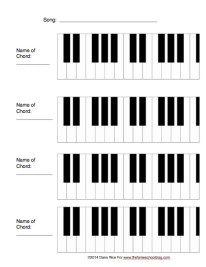
After using the worksheet for teaching 3 and 4 chord songs last week with my students I realized that coloring the black keys was a challenge. So, here is an updated version of the worksheet with the black keys blank. Enjoy!
After using the worksheet for teaching 3 and 4 chord songs last week with my students I realized that coloring the black keys was a challenge. So, here is an updated version of the worksheet with the black keys blank. Enjoy!
In a recent post I shared an important law that every piano teacher needs to know and abide by, The Law Of Friends, which essentially says that tweens and teens will practice diligently if you teach them music that their friends like. For most teens, this will mean teaching pop music. There is no need to abandon traditional repertoire altogether, but in order to connect deeply with students of this age you will most likely have to bring in some pop or jazz.
How do you do this with a student who doesn’t know enough theory or read music well enough to play songs at this level? The good news is that there are LOTS of songs that use only 3 or 4 chords and today’s FREE PRINTABLE makes it easy for you to teach them how to play these chords.
The sheet has 4 blank keyboards so that you can use it with either a 3 or 4 chord song. During your lesson, let the student know that there are only 3-4 things they must know to play this song. That puts them at ease and opens them up to what you are about to say. As you show them the notes for each chord, have them color in the corresponding keys on the sheet with a color pencil. At that point they are ready to play one of their favorite songs with a very cool sound!
Because there is no music notation involved, you can take this time to help your student understand the layout of the keyboard and how music moves. You can go as deep with the theory as your student can handle – just be sure to follow the student’s lead.
Finally, if you haven’t downloaded Tim Topham’s free e-book on teaching teens, click here to get it. It’s filled with helpful information!
If you have a deck of cards, you can put them to good use in your piano studio!
“It’s not what you do, but the way you do it that matters!”
Music theory. Keyboard topography. Rhythm. Ear training. Technique. All these are essentials of learning to play the piano, however, success in teaching these skills is determined by the WAY these skills are taught.
One of the biggest complaints of piano teachers and parents of piano students is that the child will not or does not want to practice. If you can relate to this, then allow me to give you a life changing piece of information:

Parents are busy. Sometimes they feel that they are too busy to sit and listen to their child practice piano. These same parents listen to music all the time while they are working and doing important things. So, what is the problem with listening to their child play music? It just might be that the music their child is playing is unappealing or uninteresting to the parent. Eliminate this problem by getting to know the musical tastes of the parents in your studio. A simple question in passing can get you this information. “Who’s your favorite artist / style of music / song?
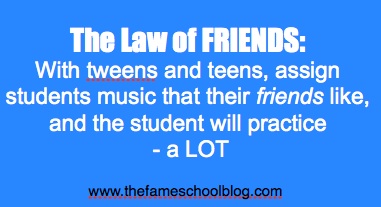
Similarly, when dealing with older students (tweens and teens) there is another law you must know as a piano teacher who wants their student to practice:
To sum it all up, music lessons should equip students to play music that they, their friends, and family enjoy hearing. The successful piano teacher knows this and abides by the law at all times!
Here are some additional FREE resources to help get you started on the road to ending the practice wars in your studio:
Teen Toolkit by Tim Topham: A FREE downloadable toolkit for teaching teens. A must read!
http://colorinmypiano.com/2013/04/09/free-printable-12-bar-blues-in-c/: Introduce the blues – no note reading, just cool sounds
8notes.com: Free riff lessons of popular music
http://www.teachpianotoday.com/2012/03/01/piano-recitals-are-like-totally-like-lame/ : Keep kids practicing with cool performance opportunities
Jazz for Kids : Use 5 finger scales to teach jazz to preschoolers
I LOVE February because of Valentine’s Day and Black History Month! There are so many great activities for music learning that can be used with these themes as a backdrop. So, with Valentine’s Day behind us today’s focus is a simple and fun music lesson with a nod to Black History Month.
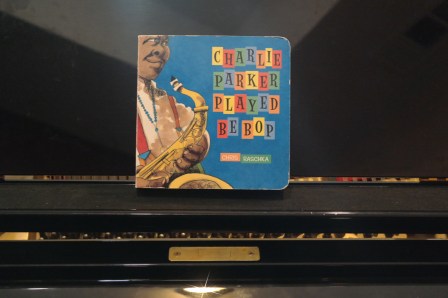
In this lesson, the student will learn how to play a jazz tune about legendary jazz saxophonist Charlie Parker using the 5-finger scale. It is designed for 3-6 year olds.
You will need a copy of the board book Charlie Parker Played BeBop and a recording of the song by Louise Rogers.
Away from the piano, play the recording of the song while reading the book with the student. Feel free to dance around, snap fingers and tap toes. Encourage your student to sing along with the call and response in the song.
Now, announce to your student that they are ready to play this song on the piano! If the student already knows some or all of the 5-finger scales have him/her play one for you. (The recording uses the Bb scale). Even if the student has not learned any scales, you can still use this activity to teach them the scale.
Your student will play the chant “Charlie Parker played BeBop” which occurs again and again in the song.
Here are the notes: C D E F G E
Once you have done this a couple of times, you are ready to play along with the book. Allow the student to turn the page and play at the appropriate time. You can even do this as a duet since it is in call and response style. Be sure they sing along!
Afterwards you can ask a couple of review questions –
“Who was Charlie Parker?” Ans. Charlie Parker played bebop.
“What instrument did Charlie Parker play?” Ans. Charlie Parker played alto saxophone.
 This Valentine’s Day Themed Conductors Bouquet is going to be used in 3 ways in my studio next week:
– To teach kids which hand plays treble clef notes and which plays bass clef notes
– To teach kids how to feel different time signatures by conducting with the wands
– As a decoration to brighten up the studio so I can see kids’ faces light up as they enter for their lessons
When students arrive for lessons, I will be playing Bob Marley’s “One Love” and Annie Lennox and Al Green’s “Put A Little Love In Your Heart”. The Student will take a wand from the bouquet and using the correct hand for the symbol on the heart join me in conducting the song. We will extend the activity by conducting some of the pieces that they are working on as well. At the end of their lesson they will get to take the wand home to keep!
Here’s what you need in order to do this activity:
1. Valentine’s Wands from Dollar Tree (They come in packs of 3)
2. A sharpie marker to draw bass clef and treble clef symbols on the hearts
3. A nice vase to keep them in
4. Songs of different time signatures
That’s it!
Before we go I have a question: What other Valentine Themed songs can you suggest with different time signatures that can be used in this lesson? Please let me know in a comment below!
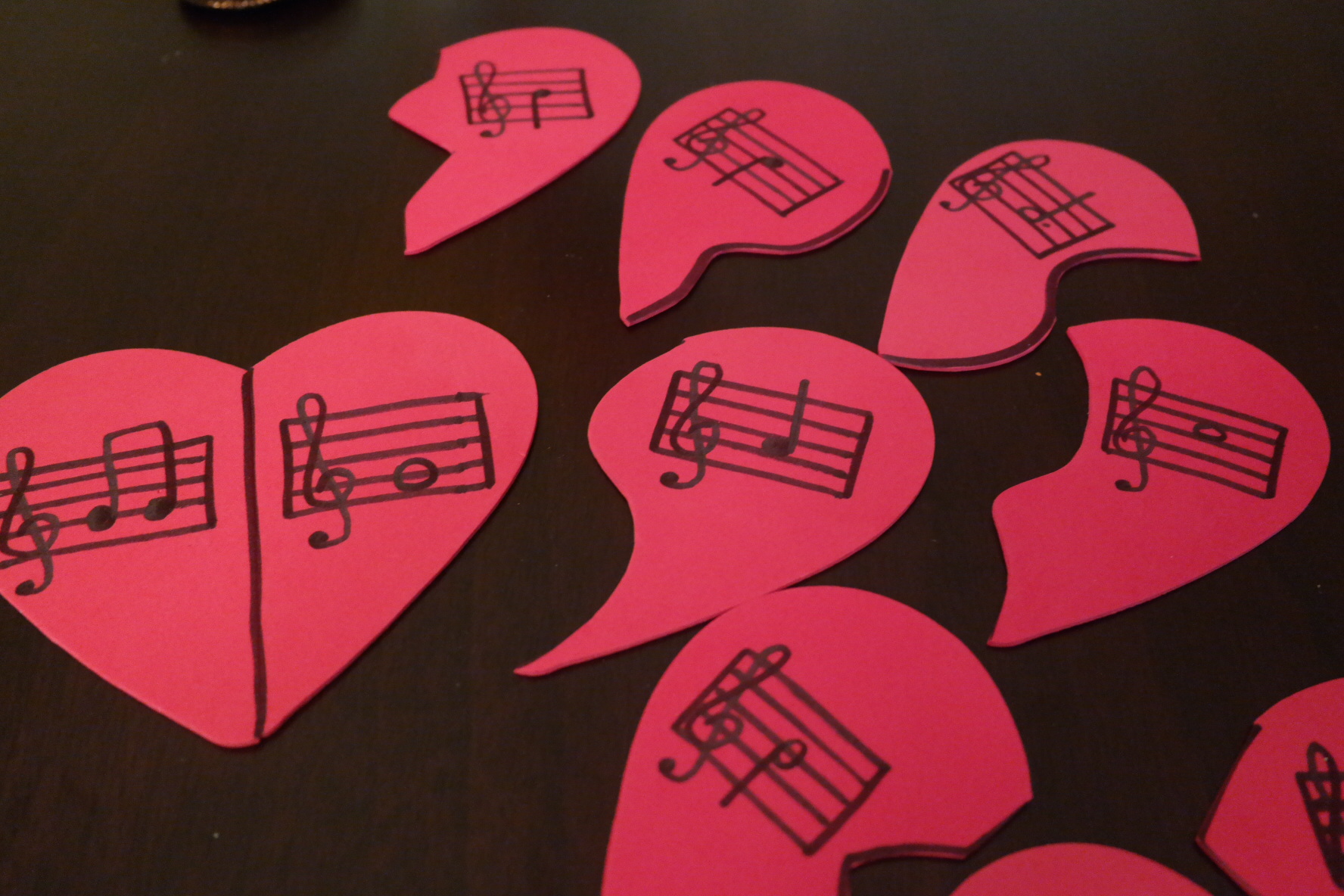 Today’s post is inspired by Meryl Brown’s One Heart Activity found on her Music Therapy Blog, Developing Melodies.
Meryl pairs Bob Marley’s song, One Love with a matching heart game to teach preschoolers to match patterns. What I think is so cute about the idea is that it plays off the Valentine’s Day theme which is all about match ups!
Her idea inspired me to create a new game that helps piano students make the connection between notes on the staff that have different values but are the same note. I find that some kids have may correctly identify a quarter note middle C in one measure but do not realize when they see a half note C in a different measure that the two notes are the same note. This quick game is a fun way to help them make that connection.
All you need is some foam heart shapes or paper hearts and a sharpie to draw the notes. Cut the hearts in half in puzzle like designs and your game is ready!
In case you missed yesterday’s post and are looking for more valentine theme piano fun click here!
 Valentine’s Day gives piano teachers loads of ways to infuse fresh excitement into the piano lesson! Today I’m highlighting an idea from Susan Paradis’ blog which helps kids review notes on the grand staff. Her great idea is centered around an intriguing question,
“Are You A Line Or A Space?”
If you are looking for a quick, fun, and effective music theory activity with a Valentine’s Day theme to start or end your piano lesson you should definitely give this one a try!
Click the video below to hear what one of my students said when I asked her the question…It will make you LAUGH!
Tomorrow’s post will feature another exciting idea from a piano blogger! In the meantime, check out these past Valentine’s Day posts from Kids & Keys:
Music Heals Broken Hearts – A Rhythm Notation Activity
Valentine Steps – Practice reading stepping patterns on a staff
Become an even wiser piano parent by reading this!
This year I have had a handful of gorgeous beginners taking lessons with me. I’m trialling new material for beginners and I need a cohort of children of different ages, genders, interests and learning styles so I can really test a range of approaches I believe will be more effective than the approaches I’ve used in the past. I haven’t auditioned these new students prior to accepting them into my studio – inviting a diverse group of children to explore the piano and learn musicianship and performance skills with me gives me my best chance of testing my material (as well as keeping me on my toes!).
Of all the diversities amongst these beginners the greatest is probably this: some children come from families of professional musicians while some come from families where no one has ever learned an instrument.
What does this mean? On the surface it means that…
View original post 2,261 more words

Go ahead, accuse me of seeing EVERYTHING through piano eyes. I can’t help it. I just do! Really I just look for ways to use things I love in my piano teaching. What’s the latest thing I love to be incorporated into lessons? The giraffe!
The giraffe is my absolute favorite animal because it’s long neck allows it to see everything. The other thing I like about giraffes is that they are pretty quiet. I like to think that it is because they are so busy watching all the things that their long neck makes it possible for them to see! Here are two ways to use this information for piano lessons:
Keyboard Topography: This works well with very young students age 5-6 and under. Using a toy giraffe that fits on the piano keys (I bought a finger giraffe from Oriental Trading Co.), place the giraffe on the G key. Help your student find all the G’s on the piano. Then read the story “Giraffes Can’t Dance”, and every time you get to the phrase “Giraffes Can’t Dance” have the student play the G key. You can even add in an extra “Giraffes Can’t Dance” after each page so that the student gets a lot of practice at finding the note.
Grand Staff Notation: This works well with students of any age. Show the student a visual of a giraffe. (I bought mine at T J Maxx and it sits on my piano). Draw a high G on the Grand Staff or Treble Clef Staff. Point out that just as the giraffe is tall enough to look down on all the other animals, the high G sits up high enough on the staff to look down on all the other notes. Then whenever your student has trouble remembering that high G note, just point to your giraffe to remind them!
That’s it! 2 lesson plans from 1 simple prop.

 Kids & Keys