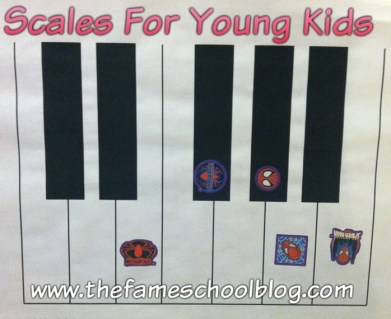
Helping kids learn and remember what notes go with each pentascale is easy with stickers and a printed piano keyboard! This is one that one of my boys made.
He is a big Spider Man fan!
Helping kids learn and remember what notes go with each pentascale is easy with stickers and a printed piano keyboard! This is one that one of my boys made.
He is a big Spider Man fan!
EVERY DAY in lessons my students show me that the music they are most interested in is Pop and Jazz. As teachers we have to listen when students tell us what they want to learn and find ways to use what we know to help them get to where they want to go. Awesome article by Leila Viss of 88pianokeys.com. Check it out!
 Hello Jazz/Pop Track attendees and those who couldn’t attend but are still interested,
First, a huge thank you! We (Bradley Sowash, Chair and all those involved) were so pleased with the number of those who participated and the enthusiasm and energy felt throughout the day.
Here’s bios and descriptions of each session and as promised, handouts from those who offered them.
Panel Discussion: Can you think of Pop 10 Reasons for Integrating Jazz/Pop styles into your Lessons?
Panel’s HANDOUT: None, but stay tuned for the top 10 list of each panelist in a future blog.
Bradley Sowash, Scott Houston, Barbara Kreader, Lauren Thompson, Kristin Yost, Marti Dudgeon, Leila Viss, Deborah How
Dialogue between and panelists and attendees discussing the pros and cons of integrating jazz/pop styles into music lessons. Attendees will be encouraged to make a list of the POP 10 reasons why to consider adding jazz/pop into daily…
View original post 1,315 more words
This is priceless.
This is an interesting article on the value of teaching music in public schools from a non-musician. The author talks about how his lack of understanding in music frustrates him and how he sees his daughter’s music teacher bring understanding to her students.
And so I find myself sitting in a music classroom of a local high school waiting for my daughter to perform. There’s another young woman seated at the piano when I sit down and I am reminded that for many students, middle school is a time of painful awkwardness…. She begins playing and I close my eyes and give my imagination to the music…and it’s beautiful. Vulgarian that I am, I even recognize it as a piece that I’ve heard before. I open my eyes and thoughts of awkwardness are gone. At the piano sits a young musician – one who just took me to a place…
View original post 82 more words
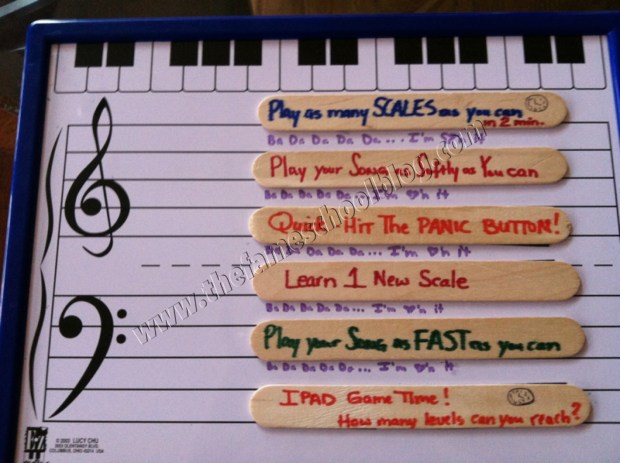
My version of How To Teach Piano In 84 seconds by Andrea Dow of the Teach Piano Today blog. Here’s how you can make it and use it in your lesson with students who have short attention spans:
1.Write out 6 activities on jumbo popsicle sticks and put a strip of flat magnetic tape on the back of each stick. (The magnetic tape sold in rolls does not work as well as the flat kind)
2.After each activity the student and I will sing the McDonald’s “I’m lovin’ it theme” before moving to the next activity.
3.Be sure to read each activity with the student before having them do it.
4. Get creative with the activities! You will notice that my 3rd “activity” is “Quick! Hit the panic button”. If you don’t have a panic button, do something like bounce a ball.
5. Notice that some activities are timed. You can draw a clock on these so students will know the activity is timed.
6. Finally, decide what order you want to do the activities in – or let your student choose – and put the magnets on a magnetic board!
That’s it – lesson accomplished!

Quick and fun theory review!
At our practice achievement celebrations this week, I drew music theory concepts on balloons and had students randomly pick 2-3 balloons. I told them that if they could correctly identify what was on the balloon, they could pop the balloon. If they correctly identified all 3 of them then they also got the joy of taking a purple balloon home with them.
I got the idea for this activity while reading Ron Clark’s book, The End of Molasses Classes. It is an AWESOME read!
I used different variations of the activity also.
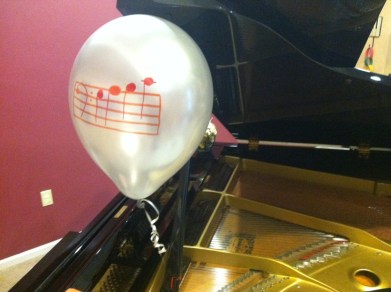
Sight Reading
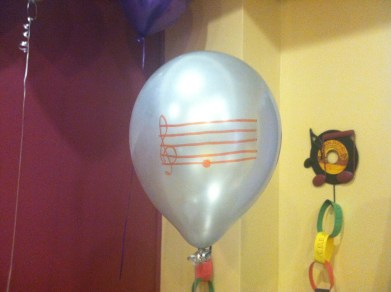
Note Identification
Finally, my favorite variation – In Family Feud Style I gave 2 students each a blank balloon. I sat them in chairs back to back and told them they had 20 seconds to draw as many music symbols as they could think of on the balloon. Whoever had the most would get to pop the balloons.
They had a blast with it!

If you watched the Grammy Awards a few days ago you know that this year they made a huge announcement. For the very first time they are creating a GRAMMY for music teachers! Hooray! The GRAMMY Foundation and The Recording Academy are recognizing the efforts of the people who teach artists the skills they use to make Grammy worthy music. That is something every music educator can celebrate.
Regular readers of this blog know how I support the work that classroom music teachers do. So, please know that I agree that they deserve the opportunity to win a GRAMMY. The last time I checked, though, to get really good at playing music most people need a private teacher in addition to their school music teacher. That’s why school music teachers often give parents a list of private instructors when kids join orchestra and band.
So, I believe that it’s up to us as music teachers to say this to the GRAMMY Foundation and ask them to consider making the award open to private music teachers. If you’re willing to join me in this, leave a comment below. Tell us about the private teachers that have influenced you and how their contribution has impacted your musical skills. Share this post with your students, parents, and social networks. Let your voice be heard!

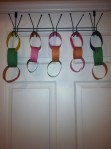
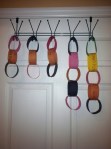
This spring my students are concentrating on learning and perfecting the major scales and pentascales. The younger students are working to learn all 12 pentascales and the older students are tackling the major scales. Their goal is to not only be able to play them fluently but to know the note names for each scale. Each time a student successfully learns a scale they add a link to their scale chain as shown above. So far, two students are tied for first place with 5 scales!
The biggest challenge so far has been helping students understand that they cannot earn a link on the same day they are introduced to the scale. They have a hard time understanding that just because they can play through the scale does not mean they know it! So, each week at the beginning of the lesson they have to play the scales they already earned links for in addition to any new scale they practiced during the week. This is helping them to realize that they have to stay on top of those scales!
What do you do to encourage students to become fluent in playing scales? Tell us in a comment below!

Here is a quick activity to get the lesson started – especially on Valentine’s Day. Students can practice recognizing and playing stepping patterns on random notes. You could also have the student try to find the matching pattern. (There is one matching set). For extra fun see if the student notices that the hearts form a star in the middle! You can download a copy of this activity here.
Happy Valentine’s Day!

Pinterest has got to be one of the greatest resources for inspiration that I’ve ever come across! While browsing the site recently I came across an activity from a school party that used broken hearts to review numbers that was pinned by Ann Berman. Someone suggested making a music matching game with this idea, so I did! I used it as a review for note and rest values. My 3 year old student LOVED it. The game was very easy to make. I used foam hearts and a sharpie to draw a quarter note, half note, whole note, and their corresponding rests on one half of each heart. On the other I wrote the number value. Then I cut the hearts down the middle in different shapes to make unique puzzles in order to make the activity self-correcting.
Do you use Pinterest? If so, leave your link in a comment below. Then hop on over to my Pinterest page and check out some of my boards.
Do you?


 Kids & Keys