Music Notation Made Easy

I recently found this
visual of the grand staff on wikihow.com which is great for quickly showing kids how the Treble Clef
and Bass Clefs are related.
After looking at the picture the phrase “Ace In The
Hole” came to my mind as a way to help kids connect the two staffs.
I often find that students have a hard time learning to look at both clefs at the same time.
They also tend to forget
the name of the note on the top line of the Bass Clef. “The Ace In The Hole” phrase can also
reenforce the concept of middle C being in the middle of the two staffs, which seems to
also be a surprisingly difficult concept for students to grasp.

Source: wikihow.com via Dana on Pinterest

Piano Photo Contest Entries: You Decide!

To celebrate completing the first month of piano lessons for this school year, I held a piano photo contest for students and families in the studio. Below you can see all the entries. Please vote for your favorite picture. The owner of the winning picture will receive a $10 Amazon gift card!

iOS with a Single App for Education (Big nod to Tony Vincent)

This has got to be the BEST feature apple has EVER added to its products! Any teacher or parent using iPad, iPhone, or iPod with kids will LOVE it!

choirguy's avatarTechnology in Music Education

Tony Vincent posted these instructions for forcing the use of a single app in the educational (or home) environments with iOS 6, which was released today.  Read his article here.

This is a wonderful addition, particularly for using iPads in music education.

Imagine this: you have four iPads that you can use with your students, which you wish to load with a PDF Music Reader, as well as to link audio files within that app, so that your students can do sectionals.  How do you make sure that your students stay on task and in the app you want them to stay in?  Guided Access.

This would also be ideal so that you could use the iPad in testing.

Fan-tast-ic.

View original post

DIY Music Theory Manipulatives!

I found this bucket of dominoes on a recent trip to Tuesday Morning for around $5! If your local store doesn’t have it you can get it on Amazon.com for $14.99. The bucket comes with 250 blank dominoes in 5 different colors. I am using the dominoes to help piano students learn to spell scales and build chords.

Using a sharpie, I wrote the letters of the music alphabet on individual dominoes. Then I drew sharps and flats on the dominoes as well. You will notice that I chose to use orange for all the sharps and blue for all the flats. There are more than enough dominoes to make a complete set of each of the 12 major scales without even using all of them. I ended up having a whole set of red dominoes left over to use for something else. I might use one side for numbers 1-7 and the other side for Roman Numerals to help students learn the scale degrees.

It took me about an hour to draw all the letter names and symbols, so if you’ve got an hour to spare now for this project it could save you several hours in the future because you can surely use this for teaching lots of theory concepts. An added bonus is that it is self – containing. The bucket easily stores all the pieces in one place!

A Staff Made Of Noodles!

I was inspired to create a 3-D life-sized musical staff after watching an episode of Quaver’s Marvelous World. I’m not crafty at all, but this is the result.

To make it I used:

5 swimming noodles purchased at Wal-Mart

4 plastic mini-basketballs purchased at Dollar Tree

2 Wooden Dowels purchased at Home Depot

Craft Paper

Tape

Now, all I have to do is figure out a way to make it free-standing!

The Musical Power of A Clothespin

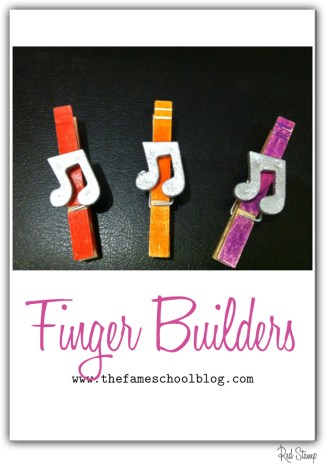
Here is a simple tool you can use to help young piano students develop stronger fingers and increase their fine motor skills. Yes, the basic clothespin can do this! I dressed mine up so that it wouldn’t look so basic. All I did was color each clothespin with a marker and add a music symbol embellishment. You can easily find these at craft stores.

Students can use these Finger Builders to squeeze with each of their fingers and the thumb. Be sure to demonstrate to students how to squeeze with their fingertip and without letting their finger collapse. This will help promote a round hand shape to use at the piano.

Another fun way to use these Finger Builders is to have the student pretend that the Finger Builder is a crocodile looking for food. Have them use it to “eat” small objects around the studio.

Most Interesting Ways To Play The Piano


This morning while reading Tim Topham’s post on The Most Unusual Places To Record Piano I was reminded of Brian Culbertson playing the piano backwards at a recent concert I attended. It was one of those moments you replay constantly in your mind. Fortunately I was able to find this video on YouTube. It has created some great discussions with my students about the importance of knowing your way around the keyboard and about entertaining your audience with your performance.


Let Them Have The Spotlight

Violin

When my son signed up for orchestra at his school a couple of years ago I learned a valuable lesson as a parent. It is a lesson that I believe that piano playing parents who have enrolled their children in piano lessons can benefit from as well. So here it is…

Violin was my son’s instrument of choice that year. He was very excited when we got home from the music store with his brand new violin. I was excited too! I had never played a violin before, but knowing that music is in the musician and not in the instrument, I decided to try playing a simple tune on it. Before my son could get in the house good, I was playing Twinkle Twinkle Little Star on his violin. Don’t get me wrong, it wasn’t perfect technique wise, but it was recognizable. I was proud of myself for being able to demonstrate that an instrument is merely a tool in a musician’s hands much like a pen is a tool in a writer’s hands. It doesn’t matter what kind of pen the writer uses – he can still write with it. Just as I was about to pat myself on the back for my musical genius (lol), I looked up to find that my son was less than impressed. In fact, he was upset.

Why was he upset, you may ask? The violin was supposed to be HIS thing, not MY thing! He wanted to impress me with his ability to play the violin and to show me that he could do something that I could not. He didn’t say this to me, but I realized it just from looking at his response. From that moment on, I did not pick up his violin  – at least not when he was home! He went on to qualify for the Honor’s Orchestra by the end of the school year and I went on being grateful that I have a healthy, happy son who is able to enjoy music all on his own!

So, what am I saying to piano playing parents? Let your children take the lead when it comes to whether or not you should play the piano with or for them. Resist the urge to show them that you can play the rest of the song that they just started learning. Give them the joy of inviting you to the piano to play along or sing along, or just listen! They will be much more cooperative because they can own their musical education. Once they feel that sense of ownership, they will be glad to share in many musical experiences with you!

How Do You Get Piano Students To Sing or Even Hum?


When it comes to music I am a firm believer that if you can sing it, you can play it. As a singer, I am completely baffled by the fact that students attempt to learn how to play the piano without being able to sing or even hum the tune they wish to play. Equally disturbing to me is the number of students who will sing the tune, but consistently do it without regard to the correct pitch. I’ve seen this over and over again in piano lessons. When I ask a student to sing the melody of the song they are learning, they look at me with a blank stare as if to say, “You can’t be serious”. Then when they realize that I am serious, they simply ignore the request as they continue to struggle through the tune. Try as I might to convince students that I am not asking for a polished professional, melodious sound they still cringe at the thought of hearing their own voice. I’m wondering what other teachers do about this. So, the floor is now open for suggestions!