This app is my favorite new find for studio invitations, thank you’s, and announcements. There are a variety of designs available and many that you can use a photo in. Once you personalize your stationery it is saved as a photo on your device for future use! How cool is that? Click here to see an example of a picture I made using Red Stamp. There are several in-app purchases available with Red Stamp, but you can make countless creations without any purchases. What makes takes this app to the next level of COOL is that it is FREE in the apples itunes store.
How Do You Use Facebook For Your Studio?
Facebook pages, timelines, and status updates are all the rage these days. So, I recently set up a Facebook Page for my music studio. You can see it at www.facebook.com/fameforlife. Facebook is such a powerful tool, but as I’ve been discovering since I set up the studio page, it can be a bit overwhelming because there is so much you can do with it. So far I’ve been able to upload pictures and videos from recent events and have even managed to get and give a few likes thanks to many of you who read this blog. By the way, if you haven’t yet added a like to my page, I’d be honored if you’d like my page before you leave!
Do you use Facebook for your studio / business? If so, what do you use it for – promotion, staying connected to clients / parents? Please share your thoughts in a comment below.
How To Get More Piano Students
Sometimes the best way to get kids interested in piano lessons – or anything else for that matter – is to have their friends tell them how much fun it is! If you take special care to keep fun at the center of your piano lessons, your students will reward you for it by telling their friends about it. And remember – kids tell it exactly the way they see it, so make sure to keep it fun because if it’s not they will tell that too!
One thing that keeps lessons fun is special projects. The sound file above is from the CD project we do in my studio. Each kid gets to record his or her own CD. Find out more about this project and how you can incorporate it into your teaching in Recording Season is Here!
FREE Concerts!
With Memorial Day just around the corner here in the United States, it’s a great excuse to have your piano player give some FREE Concerts. If you have guests coming in town or if you will be gathering with friends, why not take advantage of what you’ve invested in music lessons and let your piano player provide some of the entertainment? Music streamed through ipods and speakers is fine, but NOTHING beats a live performance from your kid!
To make it happen, get them involved right now! Suggest it casually and throw out some ideas about costumes. Kids love to dress up and they get caught up into what they are going to wear forgetting to protest about performing. And be sure to get some Funky Cool sunglasses!
Of course you will want to put out a tip jar so that guests can show their appreciation. You will need to put $2-$3 in the tip jar before setting it out so guests know that’s what it is for. Getting paid to play the piano? Now that sounds like something a kid could go for! Let them know that they can buy a new video game or some other thing they’ve been wanting with the tips.
If you really want to go over the top, get some prints of them at the piano and have them autograph the pics for your guests. Be sure to give guests the heads up that they need to ask for an autograph after the performance! For something to add that “extra touch” get invitations here.
What other ideas do you have for getting kids to play at family gatherings?
Summer Practice Challenge
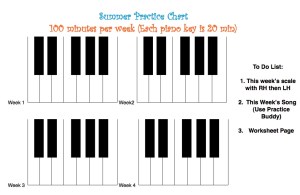
Summer is here! The school year is almost over for many kids right now and that means that parents and piano teachers have to have a plan for helping kids continue to play (piano that is) over the summer. So, here is a Summer Practice Chart you can use. The Summer Practice Challenge is to practice playing piano for 100 minutes each week. That’s only 20 minutes a day! Each day they reach their goal they get to color in, check off, or put a sticker on one piano key. If they practice this way for only 5 days they will reach their goal.
On the right side of the chart is a To Do List that takes the guessing out of what to practice. Summer is a great time to focus on scales so that is the first thing in the to do list. A summer of scales will make learning new songs in the fall so much easier and faster!
The second practice step is a new song for the week. If the child is taking lessons over the summer this is the one song that is covered in the lesson. I set a goal of learning one song a week because most people are doing more leisure activities this time of year and so there won’t be as much discipline when it comes to new repertoire. I suggest using a practice prop such as an abacus or dice to help the child do repetitions. For example, they can stop practicing a particular thing once they have played the song the number of times that the dice show.
Finally, a worksheet page reviewing theory concepts tied to the song for the week can finish off the practice session.
And the only thing left to do is color in, check off, or put a sticker on one piano key for the day!
At the end of the summer I have a gift card for ice cream for the student who practiced the most minutes over the summer.
What do you do to keep your students playing piano over the summer?
One Song Every Piano Player Has To Know

Between parents, students, and myself there sure were a LOT of birthdays in my studio this month! Great opportunity to use this “cake” that I found at a second hand store recently. And it was the perfect time to teach/review the Happy Birthday song. Out of all the songs that piano students can learn, this one will get the most use hands down because everybody has a birthday and everybody knows someone else who has a birthday, and EVERYBODY sings this song.
My “cake” comes in 4 pieces – perfect for each of the 4 lines of the song. As we learned to play each line, the student got a piece of cake. I didn’t even know that each piece makes a unique sound until we were using it in a lesson. What a bonus! The piece with the purple candle plays Happy Birthday To You!
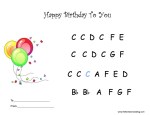
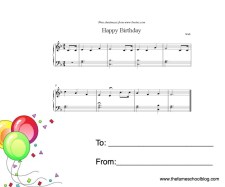
This is a great song for ear training and listening for changes in pattern between lines 1 and 2. So, that’s how we learned it in the lesson. After the lesson however, I presented the birthday person with a Birthday Certificate that has the notes for the song so they can refer to it if they forget how to play it or if they want to teach it to someone else.
Preschoolers Playing The Blues

We just had our last Preschool Music Class for the school year and it made us feel a little sad to see all the fun we had come to an end. These little ones will be heading to big school next year as Kindergarteners! So before they said goodbye to preschool I decided to show them how to make music with glasses in water. To do this, we used:
- Several small glasses that you can get at any craft store. I got mine at Michael’s.
- Water
- Food Coloring
- Small Mallet
A Piano Activity Kids Can’t Resist
Transitioning between piano lessons can be a bit hectic at times, BUT –
A simple activity can make all the difference! With a small refrigerator or magnetic board and a keyboard graphic you can squeeze in that extra precious 5 minutes that sometimes gets lost in the transition between lessons.
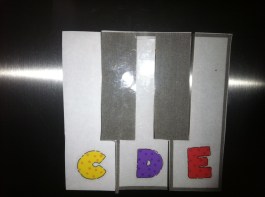
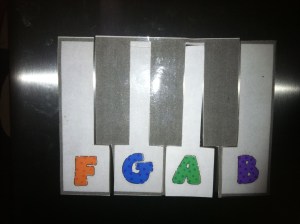
One of my favorite transitional activities is the Magnetic Piano Puzzle I made using a 1 octave keyboard printable from Wendy Stevens at ComposeCreate.com.
Print the keyboard, attach colorful letter stickers for the key names, then laminate.
Next you will cut out each of the white keys. This will leave you with a set of 2 black keys and a set of 3 black keys in addition to the white keys. Put magnetic tape on the back of each and arrange on the refrigerator.

Your student will then put the puzzle together. My refrigerator faces the studio door so it is the first thing kids see when they come in. Usually the younger ones will rush straight to the puzzle to put it together without me even asking. If they don’t and I am transitioning from another lesson, I ask them to see how fast they can put the puzzle together.
For those just learning the keys, I sometimes just put up the 2 black key puzzle or the 3 black key puzzle for them to assemble.

Extend the learning by removing certain keys from the completed puzzle so students can practice quickly recognizing which key is missing.
There are tons of ways to use this puzzle. Can you think of any? Share them in a comment below!
Music Alphabet Manipulatives
Yet another use for Play Doh!
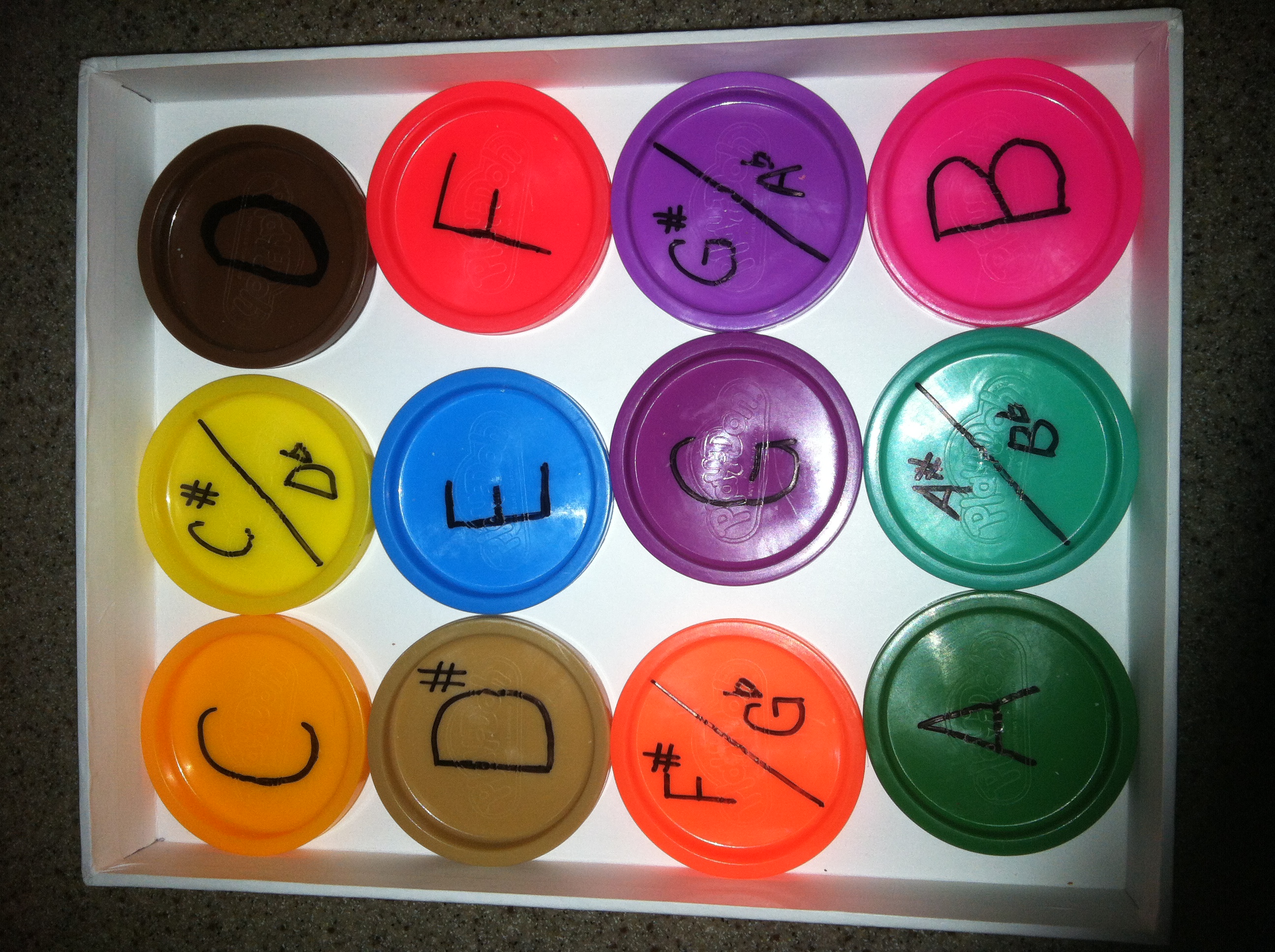
I wrote out all the music alphabet (including sharps and flats) on the tops from empty Play Doh containers. I can think of so many ways to use these in music teaching.
A colorful representation of keyboard topography
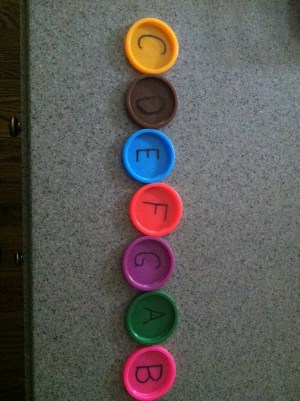
Sometimes it’s hard for students to grasp that there are 12 individual tones in music. This way they can see it in full color!
Younger ones can have races to see how fast they can put the music notes in order
-This can be done starting on ANY note so students get fluent at stepping up and down on the staff.
-Notes can be left out also so that students can name the missing note to complete the pattern.
-Students can stack the notes to build colorful chords
– If you are using a color code for piano notes/keys such as with Yellow Cat Music Education (great for students with dyslexia or who have trouble reading music notation), you can also use it when putting your own letters on the play doh caps. What fun!
Musical Mother’s Day Gifts
Here are some of the gifts my students gave their moms for Mother’s Day:
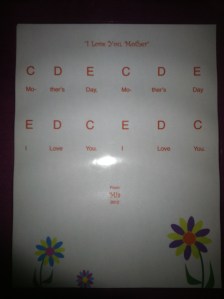
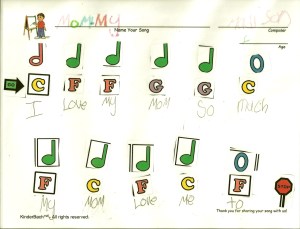
Using a composing activity by Susan Paradis, Caroline wrote a song for her mom. I took a picture of her while she was composing. Then I laminated her song and mailed the song and the picture to her mom.
Jordan made a video of herself playing her mom’s favorite songs. In the video she also tells her mom just how long it took her to get the song right! I’m guessing she wanted to make sure her mom knew just how much of herself she put into this gift!