A Piano Project Kids Love!

If you’ve been reading this blog for a while you might already know that I love doing recording projects with my piano students every year. For the past several years we have done CD’s. The first year we did a studio wide compilation CD then we moved to making individual CD’s for each child. The CD’s were a hit with parents and kids, but this year I decided to try something a little different. This year we recorded and placed the recordings inside stuffed animals at Build A Bear Workshop! Every time they squeeze their stuffed animal they get to hear themselves playing the piano!

Build A Bear Piano

How cool is that? Way cool! Even the staff at Build A Bear was impressed with these kids!


Why It’s Called The “Trouble” Clef

Trouble Clef

On a recent visit to Michael’s I found this cute little notepad. As with a lot of random things that are in my studio at any given moment, it became a teaching aid in a piano lesson. Just as I was presenting the treble clef symbol using Faber’s Queen Treble Clef song from My First Piano Adventures, my eyes were drawn to this notepad. The treble clef at the bottom of the paper was a perfect visual to reinforce the lyrics of the song which say she got in trouble for trying to play the low notes!

Hmmm, was it genius or merely desperation that led me to that discovery? Clearly there is a thin line between the two!

Quick Way To Learn A New Song

Quick Way To Learn A Song

What You Will Need:

2 or more piano students (upper elementary and older)

A song that these students like to listen to a lot

1 Die (small is fine, but GIANT is more exciting)

2 Pianos

What You Do:

Teach each student individually how to play the song by rote. (Most likely you will just teach the chorus or a popular riff in the song). You can even have the 1st student help you show the 2nd student how the song goes

Have each student go to a piano

Have each student pick a number from 1-6 and whisper it in your ear

Roll the die until one of the numbers comes up. That is the student who will play first.

The first student plays. As soon as he makes a mistake he must immediately stop playing. Now it is the other student’s turn.

They continue to take turns until someone plays it through with no mistakes. That person receives a point. If they both play it correctly, they both get a point.

 The first person to get 3 points is the winner

Why This Works for the Students:

This formula works because of 2 key ingredients: A song the students like and the friendly competition. Being the first to correctly play a song that you and your friends love significantly raises a  student’s level of cool!

Why This Works for the Teacher:

Students will be practicing without even realizing it!

Balloons In The Piano Room

Music Balloons

Quick and fun theory review!

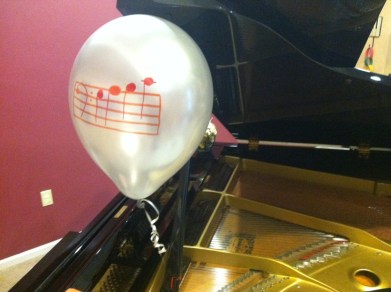
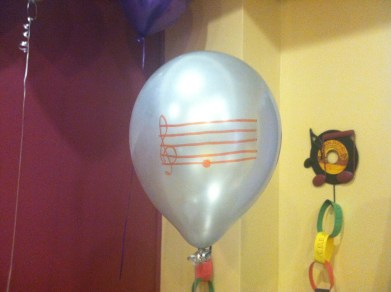
At our practice achievement celebrations this week, I drew music theory concepts on balloons and had students randomly pick 2-3 balloons. I told them that if they could correctly identify what was on the balloon, they could pop the balloon. If they correctly identified all 3 of them then they also got the joy of taking a purple balloon home with them.

I got the idea for this activity while reading Ron Clark’s book, The End of Molasses Classes. It is an AWESOME read!

I used different variations of the activity also.

Sight Reading Balloon

Sight Reading

Note Identification

Note Identification

Finally, my favorite variation – In Family Feud Style I gave 2 students each a blank balloon. I sat them in chairs back to back and told them they had 20 seconds to draw as many music symbols as they could think of on the balloon. Whoever had the most would get to pop the balloons.

They had a blast with it!

symbols

The Difference A U-Turn Can Make In Playing Scales

u-turn-sign-hi

Some piano students can’t help but play the top note of the scale twice before descending. No matter how many times you tell them not to repeat that note they still repeat it. This happened with one student this week and out of nowhere I said, “Hey make a U-turn once you get to the top.” Now this student definitely does not have a driver’s license – she’s only 6 – but she definitely understood the concept and she did not repeat that top note! You just never know what word or illustration will make it click for a piano student…


Visual Motivation For Learning Scales

Scales Links

Do you remember learning scales as a piano student? Well I do, and there was nothing exciting about it. As a student I couldn’t see how learning scales would improve my playing or what in the world they had to do with playing songs. Of course that way of thinking is exactly why it is so important to have a piano teacher! Piano teachers know that learning scales improves technical facility at the keyboard and understanding of how music works, how songs are built, and provides us with a wealth of tools for improvisation.

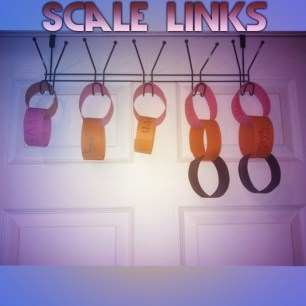
What piano teachers sometimes don’t know is how to make the process fun and interesting for students. So today I’m sharing a tool from my piano teacher bag of magic – Scale Links. Each time a student masters a particular scale, he or she gets to write out the notes of that scale on a colored strip of paper. Then the student glues the ends of the paper together to form a loop. As more scales are learned more loops are added and linked together. The scale links are hung up in the studio so that students get a visual picture of their progress. They also get to see how quickly other students are progressing which of course leads to more practice!


2012 In Review and Many Thanks!

The WordPress.com stats helper monkeys prepared a 2012 annual report for this blog.

Here’s an excerpt:

4,329 films were submitted to the 2012 Cannes Film Festival. This blog had 16,000 views in 2012. If each view were a film, this blog would power 4 Film Festivals

Click here to see the complete report.

A Child’s Ideas On How To Prepare For A Piano Performance

A Child's IdeasThis is a guest post from a 4th grader  who wishes to remain anonymous. Parents, students, and teachers will enjoy getting involved with performance prep using this piano student’s ideas! Some of my most successful teaching strategies have come from the students themselves. I love their creativity!

Play American Idol:

Have the people in the room give critiques to help the student play better.

Play Elmo Says:

Tickle Me Elmo loves to say, “Again, Again!” You should too!

Have the student play again and again and when you think they have it ask for them to play the song with their eyes closed. Any other songs the person will play that special night go through the same process. Tell them how much time is left until the night of the concert. Motivate them to try harder if they say they can’t do it. It is all in the purpose of learning that they  can do this. Play games with them to remember the song. Show the kid how they can make their playing more interesting.


Play Open & Close ‘Em:

Try to go through the whole song with your eyes closed and if you hear the wrong note open your eyes.Then put your hand in the right place to continue the song and try not to mess up on the same part.

Play Tic Tac Toe:

Instructions for tic-tac-toe – You try to play the song one time and if everything is right you make an X or O. Keep playing the song until the student wins.

Picture Book Recital Preparation:The Maestro Plays

The Maestro Plays

Performance season is here – is anybody feeling the pressure yet? I’ve certainly written a lot about performance season lately and here I am doing it again! I can’t help it! Today while shopping at a second-hand store I found this 1970 edition of a charming little picture book by Bill Martin, Jr. Although the story is not about a pianist, I’m going to share it with my students after the Thanksgiving break to help them prepare for their upcoming performances.

In The Maestro Plays,  we get to experience a full concert performance by a presumably super – talented violinist. With each page we are given new adverbs to describe how he plays  – wingingly, tingingly, drippingly. These are just a sampling of the buffet of picturesque words the author uses to arouse our imaginations. His words along with the colorful artwork in the book simulate a powerful, moving, and engaging concert performance.

I plan to read the book with each student and challenge them to apply the language used in the book to their own playing to help them experiment with different ways to convey their musical messages.

The book is recommended for ages 4-8, but I think there is still a bit of a kid in some of our older students as well. I have not been able to find many copies of the edition I purchased, however there is a newer edition with a different illustrator available as well.

I’d love to hear about things you do to get your students ready for performances! So, if you enjoyed this post and/or have performance prep tips to share please leave a comment below.

Free Printable: Personalized Piano Concert Invitations

Personalized Music Invite

Since performance season is here, I am posting a new printable today that you can email to parents who want to invite school teachers and friends to your student’s piano performance.  Family and friends are regulars at piano recitals and concerts, but expanding your audience by inviting members of the community is a great way to showcase your students to more people and to get the word out about your studio and what you have to offer as a music teacher. Get the FREE Printable by clicking here or on the above graphic.

Even if you already have printed postcards and flyers this can still be a great way to invite people who may not normally attend your show. It can also serve as an extra invite once your run out of your printed materials. Simply replace my content with the details for your event. Email to the parents in your studio and have them type in their child’s school name and their child’s name in the appropriate spaces on the printable word document. Now they have personalized invitations for their child!

Parents can choose to simply email the invitation or print copies and deliver to school friends, teachers, and administrators. Be sure to tell parents to invite their child’s school music teacher!

For more about how to put on a great piano event click here.

Did you enjoy this post? Please share it using one of the sharing buttons below!