Source: wikihow.com via Dana on Pinterest
Tag: piano
Piano Photo Contest Entries: You Decide!
DIY Music Theory Manipulatives!

I found this bucket of dominoes on a recent trip to Tuesday Morning for around $5! If your local store doesn’t have it you can get it on Amazon.com for $14.99. The bucket comes with 250 blank dominoes in 5 different colors. I am using the dominoes to help piano students learn to spell scales and build chords.
Using a sharpie, I wrote the letters of the music alphabet on individual dominoes. Then I drew sharps and flats on the dominoes as well. You will notice that I chose to use orange for all the sharps and blue for all the flats. There are more than enough dominoes to make a complete set of each of the 12 major scales without even using all of them. I ended up having a whole set of red dominoes left over to use for something else. I might use one side for numbers 1-7 and the other side for Roman Numerals to help students learn the scale degrees.
It took me about an hour to draw all the letter names and symbols, so if you’ve got an hour to spare now for this project it could save you several hours in the future because you can surely use this for teaching lots of theory concepts. An added bonus is that it is self – containing. The bucket easily stores all the pieces in one place!


The Musical Power of A Clothespin
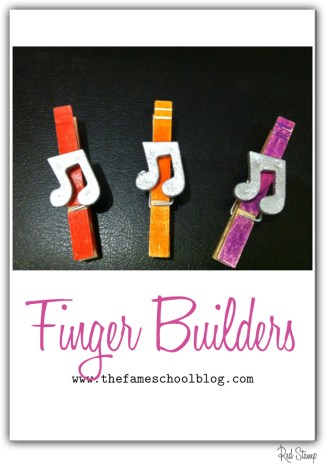
Here is a simple tool you can use to help young piano students develop stronger fingers and increase their fine motor skills. Yes, the basic clothespin can do this! I dressed mine up so that it wouldn’t look so basic. All I did was color each clothespin with a marker and add a music symbol embellishment. You can easily find these at craft stores.
Students can use these Finger Builders to squeeze with each of their fingers and the thumb. Be sure to demonstrate to students how to squeeze with their fingertip and without letting their finger collapse. This will help promote a round hand shape to use at the piano.
Another fun way to use these Finger Builders is to have the student pretend that the Finger Builder is a crocodile looking for food. Have them use it to “eat” small objects around the studio.
Most Interesting Ways To Play The Piano
This morning while reading Tim Topham’s post on The Most Unusual Places To Record Piano I was reminded of Brian Culbertson playing the piano backwards at a recent concert I attended. It was one of those moments you replay constantly in your mind. Fortunately I was able to find this video on YouTube. It has created some great discussions with my students about the importance of knowing your way around the keyboard and about entertaining your audience with your performance.
Let Them Have The Spotlight
When my son signed up for orchestra at his school a couple of years ago I learned a valuable lesson as a parent. It is a lesson that I believe that piano playing parents who have enrolled their children in piano lessons can benefit from as well. So here it is…
Violin was my son’s instrument of choice that year. He was very excited when we got home from the music store with his brand new violin. I was excited too! I had never played a violin before, but knowing that music is in the musician and not in the instrument, I decided to try playing a simple tune on it. Before my son could get in the house good, I was playing Twinkle Twinkle Little Star on his violin. Don’t get me wrong, it wasn’t perfect technique wise, but it was recognizable. I was proud of myself for being able to demonstrate that an instrument is merely a tool in a musician’s hands much like a pen is a tool in a writer’s hands. It doesn’t matter what kind of pen the writer uses – he can still write with it. Just as I was about to pat myself on the back for my musical genius (lol), I looked up to find that my son was less than impressed. In fact, he was upset.
Why was he upset, you may ask? The violin was supposed to be HIS thing, not MY thing! He wanted to impress me with his ability to play the violin and to show me that he could do something that I could not. He didn’t say this to me, but I realized it just from looking at his response. From that moment on, I did not pick up his violin – at least not when he was home! He went on to qualify for the Honor’s Orchestra by the end of the school year and I went on being grateful that I have a healthy, happy son who is able to enjoy music all on his own!
So, what am I saying to piano playing parents? Let your children take the lead when it comes to whether or not you should play the piano with or for them. Resist the urge to show them that you can play the rest of the song that they just started learning. Give them the joy of inviting you to the piano to play along or sing along, or just listen! They will be much more cooperative because they can own their musical education. Once they feel that sense of ownership, they will be glad to share in many musical experiences with you!
How Do You Get Piano Students To Sing or Even Hum?
When it comes to music I am a firm believer that if you can sing it, you can play it. As a singer, I am completely baffled by the fact that students attempt to learn how to play the piano without being able to sing or even hum the tune they wish to play. Equally disturbing to me is the number of students who will sing the tune, but consistently do it without regard to the correct pitch. I’ve seen this over and over again in piano lessons. When I ask a student to sing the melody of the song they are learning, they look at me with a blank stare as if to say, “You can’t be serious”. Then when they realize that I am serious, they simply ignore the request as they continue to struggle through the tune. Try as I might to convince students that I am not asking for a polished professional, melodious sound they still cringe at the thought of hearing their own voice. I’m wondering what other teachers do about this. So, the floor is now open for suggestions!
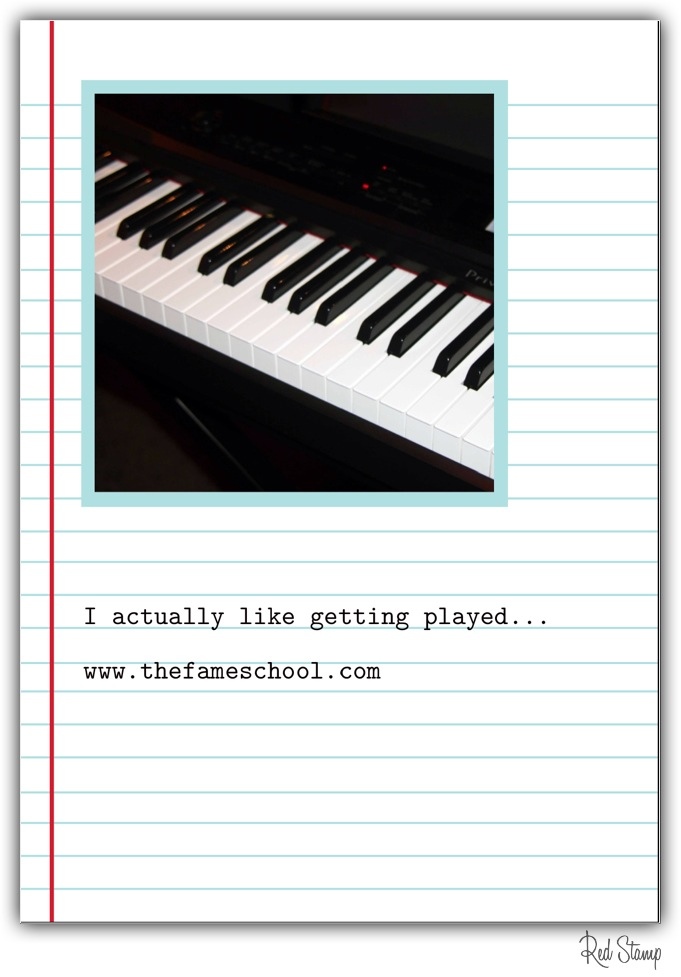
If A Piano Could Talk
Taking The Fear Factor Out Of Performing

Most of the students that I teach LOVE to perform in public! They enjoy the attention they receive from their friends and family when they play the piano. Still there are a couple of kids that I teach who, like me at their age, would rather be eaten by a lion than play the piano in front of others. Does this mean that nobody will ever get to hear them play at studio events? It doesn’t have to! Kids who are not into playing “live” can still be part of the annual Fall and Spring Concerts via pre-recorded video! If your venue has video capability, why not allow the audience to experience this students’ playing as well AND save your student the butterflies and avoid the torture of playing in public? After all, the point of the event is for others to see and hear them play – who cares if it’s pre-recorded? People LOVE watching videos and they will applaud a good performance – hello, can you say YouTube? A couple of well placed videos could be a welcome break from a string of on stage piano players during your studio event. As a bonus, the kid from the video can come to the stage and take a bow after the video is shown or have a special autograph table set up afterwards. Who knows, this could boost their confidence and inspire them to play live in the next event!
So, I’m curious readers. Have any of you done this at any of your studio events before?
Supply and Demand 101: Music Teacher’s Edition

This morning I received a very thoughtful email from a parent thanking me for the music books I had chosen for her daughter. As music teachers we spend a lot of time searching for just the right method books to use. I like to use Faber Piano Adventures, and I know that there are many teachers who would either agree or disagree with me about my choice for various pedagogical reasons. But this post is NOT about what method books are the best! This post is about why music teachers should be more concerned about the type of music their students want to play and the type of music the families of their students want to hear.
Now, the parent who sent me the email wasn’t concerned about the brand of method book. She was appreciative of the STYLE of music that was in the books. One of the first questions I ask parents and students when beginning lessons is, “What music do you like to listen to?” Another question I often ask is “What TV shows do you watch and what is your favorite movie?” These are research questions that help me determine what songs I will use to teach them how to play the piano. This approach to teaching piano is definitely more time-consuming than the traditional way of teaching, but it is absolutely essential for success with students and families. People want to learn how to play the piano in order to play their favorite music, not ours!
This is where the Law of Supply and Demand comes in. What do you think would happen if you got a student who always dreamed of playing Beethoven’s music but his piano lesson only consisted of learning blues songs? Or what if you had a student who loved pop music (and most students do), but the piano lesson only consisted of learning classical music? Well, the answer is simple – the student would most likely quit as soon as he is allowed to do so.
Now, as music teachers we have several clients for each student we teach. Yes, the student is a client, but the student’s family members are too! Remember that the family members have to listen to – or endure in some cases – the practice sessions! Consider two scenarios – Student 1 is learning music that the family members enjoy and Student 2 is learning music that the family members either can’t relate to or don’t enjoy. Which situation would most likely result in more diligent support of practice at home? Of course it is the scenario where the student is learning music that the family enjoys!
So, the Law of Supply and Demand for music teachers –
Supply students and family members with music they love to hear and the Demand for your lessons will go through the roof!