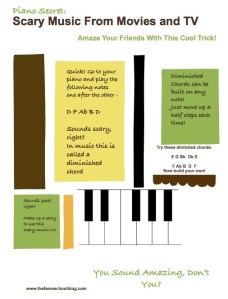
Here’s a quick and fun piano exercise piano students can learn on their own! This activity shows how the diminished chord can be used to make scary background music for a movie or TV scene. Try it out! Print a copy of it here. Come back next Monday for another Summer Piano Short!
Category: music lessons
Father’s Day Music Memories

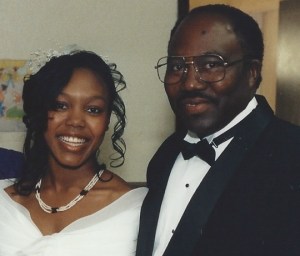
This is a picture of my Dad and me on my wedding day 17 years ago today! As I think about him on this Father’s Day a very happy memory of how he supported my music learning when I was a child comes to my mind. Although I did not live with him as a child, my Dad made sure that I had a piano at his house so I could practice when I came to visit. I was so happy when he bought that piano and I played it all the time when I was there. Today, it occurs to me just how special that was for him to buy a brand new piano just for me to use one weekend out of a month. When I consider that many of today’s parents hesitate to even buy their child a $100 keyboard when taking lessons – let alone a piano, I am deeply humbled. My Dad must have seen something musical in me even then. I am so thankful for this gift he gave me and I hope he feels good knowing that because he supported my music learning each and every one of the families that I work with is benefitting from it.
If you have parents in your studio or prospective parents who question whether or not to make the investment in a good quality piano because they are not sure if they will stick with it, share my story with them or a similar story of your own and hopefully they will want to be a hero just like my Dad is.
App of the Week: Beat Sneak Bandit
Thanks to one of the teachers in the Music Teacher’s Group on Facebook, I learned about this great music game! Wonderful for working on rhythm without even realizing it! Available on iTunes. I used it with my rising 6th graders in Music Camp this week (all boys) and they loved it!!!
Street Musicians Make Great Music Teachers!

Recently my family and I went down to Savannah, GA for my daughter’s dance performance and while we were there we were able to sneak in some music (YAY). As we strolled along the riverfront we heard the jazzy sounds of a saxophone. So, of course we went to talk to the guy who was playing. He graciously played some Duke Ellington for us and then asked what else we wanted to hear. My kids hesitated because they didn’t want to ask him to play something that he didn’t know. Of course I was pretty sure this man could play any song, so I asked him to play Blue Bossa , a jazz standard my son is learning to play. He smiled and began to play it beautifully. My kids were amazed that he could just play it on the spur of the moment like that. The lesson – continue to study music patterns and learn as many songs as you can so you will be ready to take requests some day as well!
Pinterest Idea Of The Week: Twitter Board
Source: mesmrswhitesclass.blogspot.com via Dana on Pinterest
While browsing Pinterest this morning, I found an amazing idea that I can’t wait to use in my studio this week! The Twitter Board is a place where students can write “tweets” about something they learned during their lesson or something that inspired them during the lesson. This reinforces the learning and when other students read it, they learn as well. How cool is that?
Quaver’s Marvelous World
I am so excited about this music teaching resource! If you are looking for a fun, fresh, new way to introduce music theory concepts to kids this is it! Although it is designed for classroom use, I am finding it very useful in private piano lessons. My students love the entertaining and engaging videos. There is also a companion website where kids can explore the music concepts in-depth, and it is so much fun!!! I cannot say that enough because with kids, it’s all about fun.
If you order the DVDs, you will get awesome teaching guides, worksheets, and access to online helps as well. A word of warning, though – the DVDs are expensive. Each DVD contains 2 episodes for about $69. I was so impressed with the youtube previews and their website that I felt it was worth the investment – especially since I can use it with all my students – and I am not disappointed! You can get more information on their website at www.quavermusic.com
Have you tried Quaver’s Marvelous World in your studio? If so, I’d love to hear your thoughts on it and how you use it.
Summer Piano Shorts: Arpeggios Make Great Intros
This is the first in a series of what I call Summer Piano Shorts. These are just quick piano experiments for my piano students who are taking the summer off from lessons. You can download a copy of this worksheet to use at home or with a student. They will be able to play a nice intro for songs using arpeggios. Look for a Summer Piano Short every Monday!
First Piano Lesson Activity: Piano Keyboard Pattern Cards
Young children often get confused at the piano and can’t remember where the notes are because they get lost in the sea of white keys. Of course as piano teachers we always direct them to look for the black key patterns of 2 and 3, so while reading a post from Sheryl Welles at Notable Music Studio I got an idea for this simple keyboard patterning game. It is great to use at a first piano lesson.

What you need:
Foam Sheets in 2 different colors (purchase at a craft store or a dollar store)
Piano Keyboard Printable (enough for 3-4 octaves)
Glue
Timer
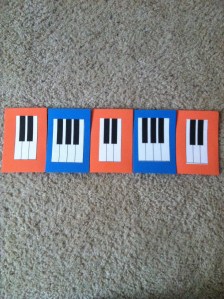
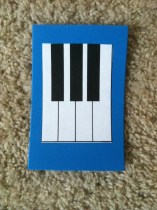
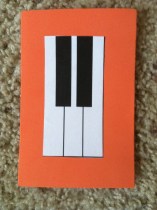
The cards will look like this:

To Play:
After introducing the student to the 2 and 3 black key groups on the piano, use this quick game to test their understanding. Have them line up the cards in a keyboard pattern. Time them and see how fast they can do it!
To extend the learning, have them make a set to take home. At home they can teach younger siblings or parents the keyboard pattern!
Activities for Waiting Students and Siblings
One of the most distracting things that can happen during a music lesson is for a waiting student or a little sister or brother to interrupt and ask, “What can I do now?” To eliminate this problem, or at least minimize it I set up a Waiting Activity Area in my piano studio. Here is a mini tour of it:
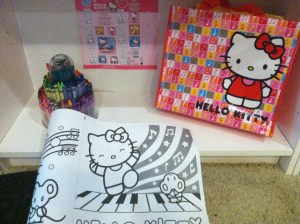
For those who like to color, Hello Kitty music coloring pages. Kids can look inside the bag for more coloring activities.
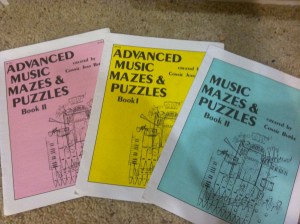
Kids who like puzzles and challenges can choose this.

Great practice on staff notation. Color by Note sheets!
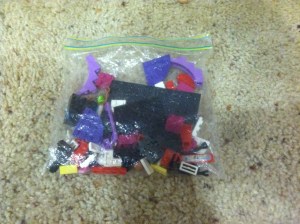
For those who love to build things, LEGOS! Of course they must build something related to music!

A game to practice the music alphabet. Kids can stack the cups in order or build chords!
Each of the activities in the center have something for the kids to show me when they have completed it, so they do get it done. I’ve also made my ipad or iphone available with music apps to play in the waiting center.
I’d love to hear what kinds of things you keep in your studio for waiting students and siblings. Make a comment below!
…Oh and come back tomorrow for the post about the music store field trip that I promised!
How Can I Know If Piano Is Right For My Child?

Sometimes I get calls from parents who are somewhat interested in enrolling their child in piano lessons but are a little reluctant because they are not quite sure if their child will be interested enough to stick with it. I always tell parents that when dealing with children and piano lessons the parent needs to be able to commit to at least a school year of lessons before making a final assessment of whether or not this is right for their child. The reason for this is that learning to play an instrument is a slow process for most people since there are a variety of skills that must be learned. This takes time and dedication. Truthfully, there will be lots of days when the child will need the parent to encourage him or her to stick with it. The following is a list of clues that can help parents know if piano might be right for their child:
1. Your child gets excited whenever they hear music.
2. Your child often sings along with music or makes up her own songs to sing.
3. Your child sings in the tub/shower.
4. Your child loves to dance.
5. Your child watches other people play instruments with great interest.
6. Your child asks you to get him lessons.
These are just a few clues that learning a musical instrument might be right for your child. If your child exhibits any of these behaviors, give lessons a good try – at least a year and see what happens. They will love it and stick with it as long as you show a genuine interest in it (at home and at lessons) and you have the right teacher!